|
|
|
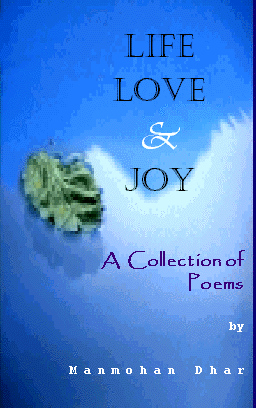
ISBN 81-85160-06-6
Number of pages-64
Size-8.5"x5.5"
Price:Rs.120/-, US$ 4.00
|
Life Love
& Joy
Manmohan Dhar
Manmohan
Dhar’s greatest reward
has been his relationship with people. It became for him an aid to
unfoldment of his inner ‘self ’ in which the basic ingredient has
been love, mutual self respect and joy. He believes in worshiping God
with Joy. His poems are outpourings of his inner personality and he
believes in propagating joy through his relationship with people.
Excerpts from his poems
-
"The
essence of life, is how you live, Not how much you get, but how much
you give"
"....with my hands stretched, I stand at my doorstep waiting, for
the needy to bless me, With their acceptance of my offering."
|
|
----------------------------------------------------------------------------------------------------
| Kashmir’s
geography and place in the cultural mosaic of India, the
relevance of the Indian values in the survival of the human
race, the emergence of religious fanaticism, in pushing the
world civilisations to rid the world, by their joint will, of
the conflict slammed on humanity in the name of God, the
clarion call of swami Vivekananda on the 27th September, 1893
at the parliament of religions held in Chicago USA, all these,
lead us to see a Divine Hand in the shape of things to come.
Excerpts from
some of Swami Ashokananda ji’s letters written to Manmohan
Dhar between 1955 to 1966, are presented for the benefit of
humanity to establish a sense of direction, a sense of divine
purpose of creation itself, torn as it is, between the
ephemeral and sensuous pursuits of present day living...
...the
construction of his sentences and the steadiness of his hand
writing, even in a twelve page letter; hits one as an
overwhelming evidence of a super-mind: steady, clear and
having his vision, in a time-frame that is ‘timeless’
"We
want to lead mankind to the place where there is neither the
Vedas, nor the Bible, nor the Koran, yet this has to be done
by harmonising the Vedas, the Bible and the Koran."
"Mankind
ought to be taught that religions are but the varied
expressions of THE RELIGION, which is Oneness, so that each
may choose the path that suits him best". |
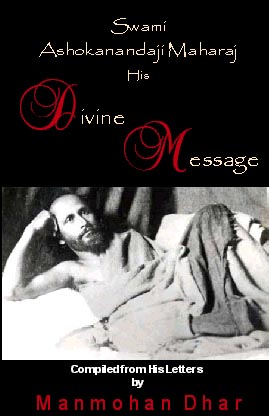
ISBN-81-85160-06-4
Pages:92
Color plates:8
Price:Rs.175, US$5.95
|
|
|
Ramakrishna
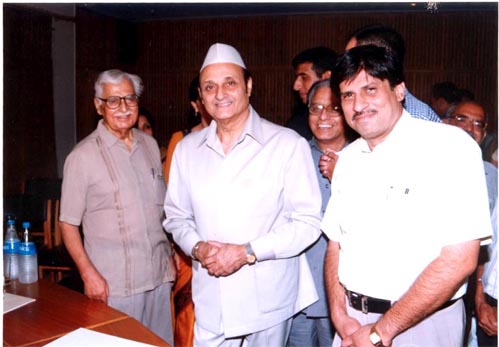
Mahasamelan Trust - Release of book by Dr Karan Singh
Dr.
Karan Singh with Mr. Manmohan Dhar
Sri
Ramakrishna Mahasamelan Trust organized a function on 27 August 2002
at India International Center, New Delhi,
to release a book titled "Swami Ashokanandaji Maharaj, His
Divine Message" compiled by Mr Manmohan Dhar from the
letters written to him by Swamiji. The book was released by
Dr Karan Singh amidst an emotional gathering of Swamiji's
devotees. The whole atmosphere was disciplined and serene with
shrine-like ambience, inspite of a much larger gathering than expected.
Many eminent people who had close association with
Swamiji were present to commemorate the
occasion because anybody who had come in contact
with Swamiji directly or indirectly was influenced
forever by his quiet but powerful and spiritual personality.
Swami Ashokanandji was born in East Bengal,
left his home at the age of eight and took shelter
in the Ashram of Swami Satchitananda ji,
who was a disciple of holy Mother, Ma Sharda Devi, wife of Sri
Ramakrishna Paramhans. He was sent to Kashmir at the
age of 22 where he lived at Nagdandi Ashram till he passed away at the
age of 60. He was highly enlightened in the highest tradition of the
order of sanyasins but his love and commitment for
Kashmir reflected the vision of Swami Vivekananda when he said
"We want to lead mankind to the place where there is
neither the Vedas, nor the Bible nor the Koran? On the banner of
every religion will soon be written”help and not
fight" "assimilation and not destruction" "harmony
and peace and not dissention?" This Kashmir is a
veritable heaven on the earth? I am trying my best in starting a
center here. So much to do here and the material so
hopeful."
Mr Manmohan Dhar welcomed the guests after
which Dr Karan Singh lit the lamp and paid his tribute
with reverence to the images of Sri Ramkrishna Paramhans,
Ma Sharda, Swami Vivekananda
and Swami Ashokanandaji. Thereafter, Mr Rajinder Kachroo and Mrs
Shevanti Sanyal enthralled the audience with a few devotional
songs.
The occasion had a special significance as Dr Karan Singh and his wife
used to visit the Nagadandi Ashram and knew Swamiji, which made his
remarks more pertinent. Dr Singh, in his
inimitable style spoke eloquently about
Kashmir, its current crisis, reminiscing
the cultural, spiritual and secular history of Kashmir, about
great saints like Swami Lakshmanju, Pandit Gopi Krishna
and Swami Ashokanandaji, who influenced him greatly.
He hoped that the vision of such great saints would soon ensure
human dignity irrespective of religion, caste, creed and rank.
He also wished the Ramakrishna Mahasamelan Trust all success to
achieve its objectives to promote harmony between all religions.
After Swamiji's passing away, The
Nagdandi Ashram was handed over to Vivekananda
Kendra and has been well managed by Sri Vivek Roy for the last
13 tumultuous years .This place has developed into an epicenter of
religious amity, love and catholicity in the vale of Kashmir and
world at large. A film was shown before conclusion of the
programme. The film shows the proceedings of a function on the 21st
and 22nd of April, which was attended by Hindus, muslims and sikhs.
Shree Faroukh Abdullah attended the function and emphasised the
need for religious amity so badly needed in this troubled world today.
He laid a foundation stone of a gate to be built
which will be named "Parahansa Dwar" and dedicated a sarovar
to the nation and named it Swami Ashokananda Sarovar.
The book titled”Swami Ashokanandaji Maharaj? His
Divine Message" and another book titled
"Life, Love & Joy" - a
collection of poems by Mr Manmohan Dhar were
distributed at the function.
The Meeting ended with a vote of thanks by Shri Makhan Lalji Raina a
saint and an enlightened disciple of Swami Ashokanandji Maharaj and
now a successful
businessman. |
|
|
|
|